How Human Knowledge Compounds: From Spoken Language to Synthetic Intelligence
A useful idea gets more powerful when the next person can build on it.
That sounds obvious until you consider how difficult it used to be. Someone had to remember the idea, explain it, preserve it, carry it somewhere, or teach another person how to use it. Each step introduced friction. Good information could disappear with its only keeper. A discovery could remain local for generations.
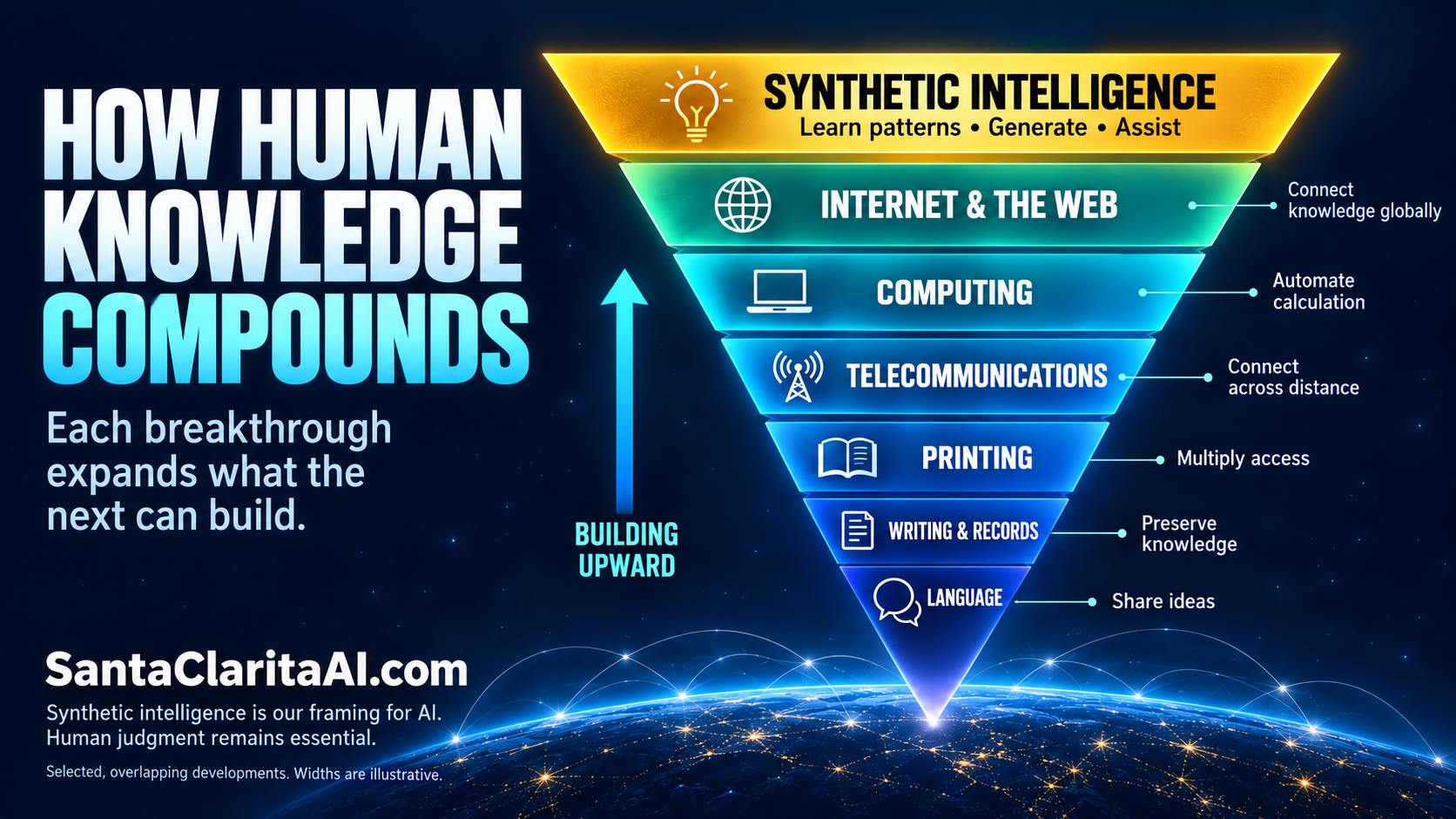
Humanity gradually developed ways to reduce that friction. Speech made experience shareable. Writing gave information a life beyond the speaker. Printing multiplied copies. Telecommunications accelerated delivery. Electronic computing made large amounts of calculation practical. The Internet and Web connected people, documents, and services. Today's generative AI can help transform that accumulated material into explanations, drafts, and other outputs.
The result is a useful way to understand our moment: human knowledge can compound when we preserve what works, make it accessible, and improve it through use. The same channels can also compound mistakes.
TL;DR: The Knowledge Pyramid in Plain English
- Language helps people share experience and coordinate action.
- Writing helps information survive beyond a conversation.
- Printing makes repeatable distribution more practical.
- Telecommunications move messages across distance faster.
- Electronic computing processes information through programmed operations.
- The Internet and Web connect information and make it easier to find.
- Generative AI adds new ways to work with that information, with meaningful limits.
Each layer depends on people and earlier capabilities. Wider access and faster output create opportunities, but sound judgment, evidence, and accountability determine whether those opportunities become useful knowledge.
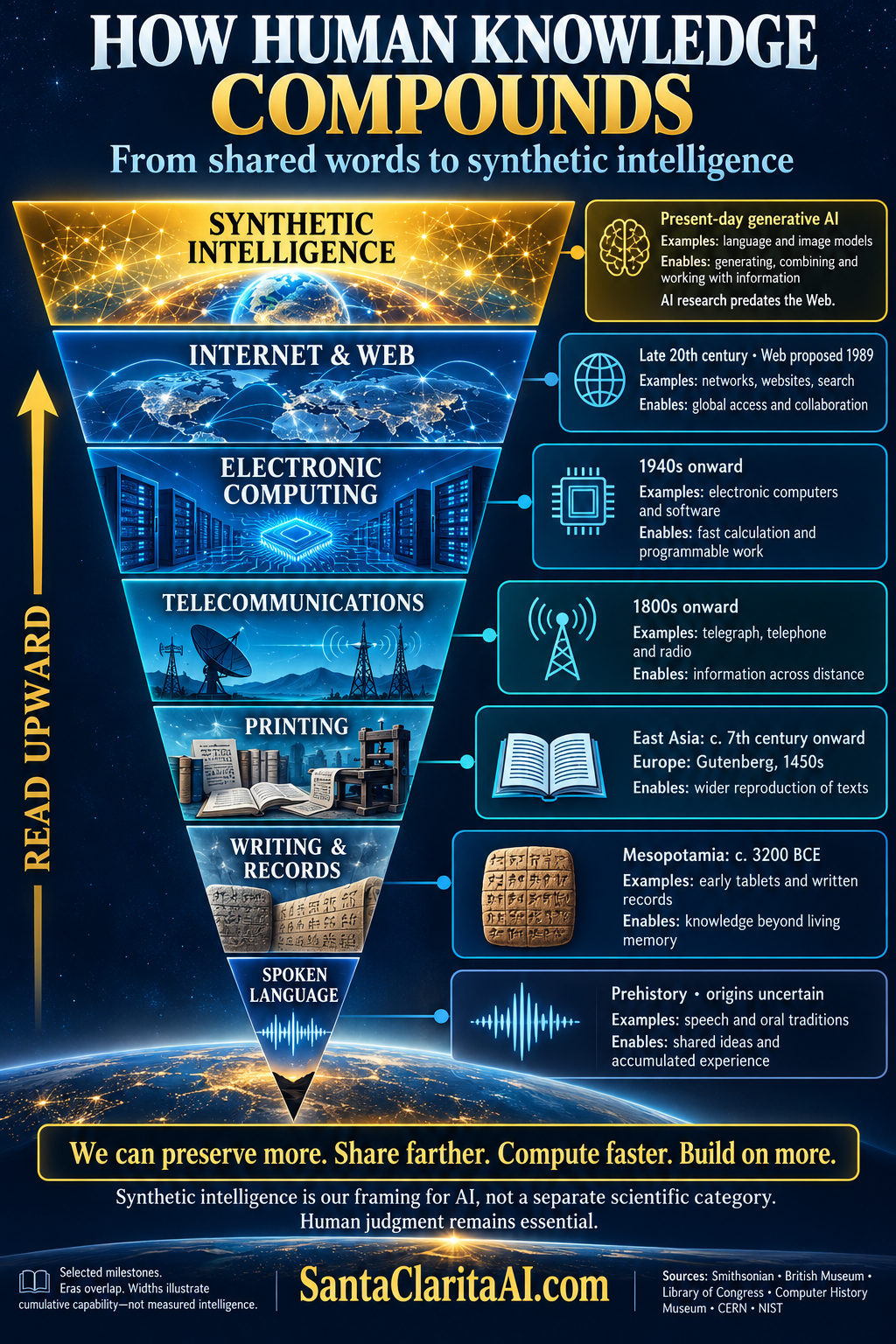
How to Read the Inverted Pyramid
Start at the narrow bottom with spoken language. Move upward through writing, printing, telecommunications, electronic computing, the Internet and Web, and today's generative AI at the widest top.
The expanding shape represents the growing possibilities for storing, distributing, processing, and reusing information. Its width is illustrative. It does not measure intelligence, historical importance, or the amount of knowledge created in an era. Language occupies the narrow foundation because everything above depends on shared meaning, not because early people were intellectually small.
The layers also overlap. People still teach through conversation, read printed books, and use ordinary software. Different societies developed and adopted these capabilities at different times. There was no universal schedule, and no invention guaranteed the next one.
Think of the pyramid as a map of capabilities. It helps explain how a question spoken into a phone today can draw on centuries of recorded work while still requiring a person to decide what the answer means.
Spoken Language: Experience Becomes Shareable
Imagine knowing where water remains during a dry season. Without an effective way to communicate, much of that knowledge stays inside your own experience. With language, you can describe a route, warn someone about danger, and explain what changed since the last visit.
Other people can ask questions. They can correct details. They can pass the explanation along without repeating every discovery themselves. Learning becomes a shared activity.
We cannot assign spoken language a confident birthday. Speech leaves no direct fossil record. The Smithsonian explains that researchers look for indirect clues in objects and behavior, while the timing of complex language remains uncertain. Smithsonian: Language and Symbols
That uncertainty matters. A neat graphic can make a speculative date look settled. The safest foundation is an era, with the uncertainty visible.
Oral knowledge also deserves more respect than a simple technology ladder sometimes gives it. Demonstration, storytelling, repeated practice, and conversation can carry context that a document misses. Anyone who has learned a difficult physical skill understands the difference between reading directions and receiving useful feedback.
The limitation is reach and continuity. A lesson depends on someone being available to teach it and someone being able to retain it. What happens when a skilled employee leaves with years of unwritten knowledge? A modern business can experience the same basic problem. Important know-how exists, but access depends on a particular person being in the room.
Writing: Information Outlives the Conversation
Writing changes that arrangement. A message can wait for its reader. A record can be compared with another record. A person who was absent can examine what was recorded and question it.
Cuneiform developed in ancient Mesopotamia before roughly 3200 BCE, with early uses connected to bookkeeping. The British Museum describes scribes tracking goods and rations in cities such as Uruk. Writing also emerged in other regions, including Egypt, China, and Mesoamerica; the world's written traditions cannot be reduced to one straight line. British Museum: Cuneiform and the invention of writing
The bookkeeping connection is practical. Before discussing grand theories, people needed dependable ways to answer everyday questions: How much came in? How much went out? What was agreed?
Consider a simple instruction for maintaining equipment. Spoken advice helps one worker. A written procedure can help a later shift. If someone discovers a safer sequence, the procedure can be corrected. The improvement has somewhere to live.
That is an early form of compounding: retained experience becomes a starting point for someone else.
Yet a record also reflects whoever created it. What did they measure? What did they ignore? Whose account became official? A written claim can look authoritative even when its assumptions are poor.
The modern version appears in customer records and operating manuals. A beautifully organized database may preserve an outdated address or an unverified promise. Documentation makes information durable. Its usefulness still depends on accuracy, interpretation, and the ability to correct the record.
Printing: One Text Can Reach Many Readers
Hand-copying a document takes time. A reproducible printing process changes the economics of distributing the same material to many people.
Printing developed in East Asia centuries before Gutenberg's work in Europe. The British Library describes printing emerging in China around the seventh century. Gutenberg's fifteenth-century work belongs within that longer history. The Library of Congress explicitly cautions against calling him the inventor of printing. British Library: Life in Ancient Dunhuang and Library of Congress: Gutenberg
The important shift for this pyramid is repeatable distribution. Multiple readers can examine copies of a text without requiring someone to rewrite each one by hand.
That gives an idea more opportunities to encounter criticism, adaptation, and practical testing. A reader can challenge a claim. A teacher can build a lesson around it. Another writer can compare it with competing explanations. Printed material can become a common reference point for people who have never met.
Access still depends on money, literacy, language, distribution, and permission. A printing press does not automatically create an educated public. People need the opportunity and freedom to engage with what it produces.
And the press can reproduce a mistake as efficiently as an insight. The number of copies does not establish truth.
This is familiar territory for anyone publishing online. One weak assumption can become an article, a newsletter, a social post, and a training document. Repetition gives it the appearance of independent confirmation when all four versions may trace back to the same unsupported claim.
The enduring lesson from printing is to distinguish distribution from validation. More readers make wider learning possible. They do not remove the need to check the original evidence.
Telecommunications: Distance Stops Setting the Pace
A printed message still needs to travel. Telecommunications changed how much that delivery depended on physically moving the document.
Samuel Morse's Washington-to-Baltimore telegraph demonstration on May 24, 1844, is a familiar milestone. It sits within a broader history of signaling systems and telegraph development rather than marking the first time anyone communicated over distance. Library of Congress: Morse Timeline
Telegraphy, and later telephone and broadcast systems, expanded the ways messages could cross distance. A distant event could become relevant to local decisions much sooner.
Picture a business waiting for confirmation that a shipment is available. When communication takes days, the business must make decisions with a long information delay. Faster communication allows a quicker adjustment. It also changes what customers and suppliers expect.
This layer introduces a distinction that still matters: having information sooner does not mean having enough information.
A short message may omit the conditions that make it understandable. A breaking report may arrive before anyone has verified it. A person may feel pressured to answer because the channel is immediate, even when the right response requires thought.
Every new gain in speed creates a corresponding need for discipline. What deserves an immediate reaction? What needs clarification? Who should be interrupted?
Business owners face that problem in calls, texts, and notifications every day. A fast channel is valuable when it carries the right message to someone who can use it. Otherwise, increased speed can simply distribute confusion sooner.
Electronic Computing: Instructions Become Repeatable Work
Electronic computing adds a different capability: carrying out programmed operations at a scale and speed that changes what people can attempt.
The public unveiling of ENIAC in 1946 is one useful milestone in a larger history of mechanical, electromechanical, and electronic machines. The Computer History Museum describes its electronic design and the substantial physical equipment required to run it. Computer History Museum: 1946
For a reader today, a spreadsheet offers a simpler illustration. Enter a set of numbers, define a calculation, and change an assumption. The result updates without someone repeating the arithmetic by hand. The value comes from making a defined operation repeatable.
This helps explain why computing became so important to knowledge work. Researchers and businesses could handle calculations, records, and models that would otherwise demand much more manual effort.
But a computer can follow a flawed instruction consistently. A spreadsheet can calculate perfectly while using the wrong definition of revenue. A model can produce precise-looking results from assumptions that do not fit reality.
The questions therefore move upstream: What are we measuring? Which instructions are appropriate? What does the output leave out?
This is especially important when discussing AI. Ordinary software remains essential. A reliable calculation or a clear rule may solve a problem more directly than generated language. The pyramid includes cumulative capabilities, and choosing among them is part of good judgment.
The Internet and Web: Knowledge Becomes Connected
The Internet and the World Wide Web are related, but they describe different things. The Internet connects networks. The Web is a system of linked resources and services that operates over that infrastructure.
The Internet developed through work preceding the Web by decades. Tim Berners-Lee proposed the Web at CERN in 1989, and CERN released Web software into the public domain in 1993. Those are useful landmarks, not a complete account of the many people and institutions involved. Internet Society: Internet History and CERN: The Birth of the Web
For the person seeking an answer, the difference is enormous. A document can point directly to another document. A correction can become available without waiting for a new printed edition. Someone can compare explanations from several places in one sitting.
The search problem changes, too. When information is scarce, finding anything can feel valuable. When information is abundant, the difficult work becomes identifying what is relevant, current, and dependable.
Local real estate makes the distinction concrete. A person researching Santa Clarita homes and open houses can move between listings, neighborhood information, and questions about a specific property. The usefulness of that access depends on current details and appropriate verification. Yesterday's schedule may send someone to the wrong place today.
A connected page is also only part of the picture. Important knowledge may remain offline, private, undocumented, or difficult to search. Search results are a view into available material, shaped by what was published and how it was organized. They are never a complete inventory of everything worth knowing.
Synthetic Intelligence: Working With the Accumulated Material
I prefer the phrase synthetic intelligence because it emphasizes something worth remembering: people have engineered these systems, and the material they generate draws on patterns learned through training. Here, the phrase is a framing choice for discussing AI, not a claim that a new scientific category has been established.
My companion article explains why I say synthetic intelligence and applies that framing to everyday business workflows.
Generative AI is the more specific technical term for systems that produce content such as text, images, and audio based on learned patterns. NIST's definition centers on generating synthetic content derived from characteristics of input data. NIST: Generative AI
AI research also began long before the recent popularity of chat interfaces. The Dartmouth summer research project in 1956 is an important milestone in the field. The top of this pyramid represents today's generative-AI capabilities, not the birth of all artificial intelligence. Dartmouth: The Founding and Future of AI
Why the New Interface Matters
Earlier layers helped us preserve information, distribute it, process it, and find it. Generative systems add useful ways to transform it through a conversational interface.
For example, a business might provide an approved service guide and ask for a clearer explanation for a first-time customer. A teacher might request several ways to explain the same idea. A writer might compare possible structures before drafting an article.
The potential value is the reduced effort between having material and doing something useful with it. A person can explore alternatives without preparing every version manually.
Voice brings the history back to its foundation. An application such as HireAIVoice connects spoken questions with business information and an intended next step. That combines language, telecommunications, computing, network access, and generated responses in one interaction.
Why Fluency Needs Verification
A persuasive answer can still contain invented details. NIST identifies confidently presented false content, often called confabulation or hallucination, as a generative-AI risk. NIST: Generative AI Risk Profile
An assistant can therefore help prepare an explanation without becoming the final authority on its truth. Its usefulness depends on the task, the available evidence, and the checks around the output.
The widest layer says nothing about consciousness or universal superiority over people. It illustrates expanded capabilities for working with information. Whether a particular system helps with a particular job is a question that needs evidence.
What Actually Compounds?
The quantity of content is only one part of the story. Useful knowledge compounds when people can retain a lesson, retrieve it in the right situation, test it, and improve what comes next.
Suppose a small service company repeatedly receives the same confusing question. One employee develops a clear explanation. The team records it. A second employee spots an exception and adds it. Later, the company makes the explanation easier for customers to find.
Each improvement saves the next person from starting over. That is compounding on a scale a business can actually recognize.
Now imagine generating fifty new versions before anyone resolves the exception. The volume increases, but the underlying knowledge has barely improved. Worse, inconsistent versions may make the next answer harder to trust.
This is why connecting information to an accountable process matters. The business-workflow focus at HonorElevate sits in this practical territory: what happens to an inquiry, where its information belongs, and who owns the next step. A record becomes useful when someone can act on it appropriately.
The strongest result may be less repeated work rather than more published material. A customer receives a consistent answer. An employee finds a reliable explanation. A correction reaches the places that depend on it.
That perspective changes how we evaluate progress. Ask whether people understand more, make fewer avoidable mistakes, or resolve the right problem sooner. Counting outputs alone misses the part that matters.
The Improvement Has to Survive
There is another condition: the next person must be able to tell what changed and why.
Suppose the service company improves its explanation after discovering that one model of equipment needs a different procedure. If the new document quietly replaces the old one, an experienced employee may keep using the earlier version. A customer may have saved a copy. Two people can now be acting in good faith with different instructions.
The correction becomes more valuable when its context survives with it. People can see which situation it applies to and understand why the earlier explanation changed. That also gives them a way to challenge the correction if new evidence appears.
This is a different kind of growth from simply adding pages to a library. It improves the relationships among claims, evidence, and decisions. A smaller collection of trustworthy, understandable material can be more useful than a much larger collection that nobody can interpret confidently.
There is no reason to assume that every stage of the pyramid produces that improvement automatically. More storage may preserve a contradiction. Faster distribution may spread it. Generated summaries may conceal it. Compounding works in our favor when the system helps people identify the contradiction and resolve it, with enough context left for the next person to learn from the resolution.
Every Expansion Changes Power and Responsibility
Who can speak? Who can read? Who can publish? Who controls the network, the search interface, or the model?
Those questions run through the whole pyramid. A capability can become more widely available while important control remains concentrated. A person may gain access to information without gaining a meaningful voice in how it is collected or presented.
The diagram also hides work. Records require maintenance. Networks require infrastructure. Software requires people to design, test, and operate it. Knowledge systems depend on material resources and on human labor, including work that an elegant interface makes easy to overlook.
For businesses, responsibility becomes especially clear when an output reaches another person. A generated answer may affect someone's expectations, time, money, or trust. The fact that software produced it does not settle who should correct it.
Consider an assistant that turns a tentative appointment request into an apparent confirmation. The words may be polished. The customer may reasonably rely on them. The important distinction is whether an authorized booking actually exists.
Or consider a summary that removes a crucial exception from a policy. Shorter wording can be easier to read and less accurate at the same time.
The question of what a business should never let a machine decide belongs here. These are questions about meaning, authority, and consequences. They existed before AI, and faster generation gives them more urgency.
Progress therefore requires more than access to a powerful tool. It requires people who can notice errors, question assumptions, preserve context, and take responsibility for what reaches others. History gives us reasons for ambition and reasons for care. Both belong in the same conversation.
Some Knowledge Resists the Diagram
The pyramid is also incomplete by design. It cannot show everything involved in learning to judge a situation well.
A written description of a conversation leaves out some of its timing and tone. A recording captures more, yet still cannot supply every relationship or obligation that gives the exchange meaning. An experienced person may recognize a problem through details that were never captured in the available records.
That is a reason to value human participation throughout the structure. Better tools can make expertise easier to share, but deciding what deserves attention remains part of the work. A sensible future leaves room for explanation, disagreement, and learning directly from other people.
Common questions
What does it mean for human knowledge to compound?
Knowledge compounds when preserved experience helps other people learn, test ideas, and make further improvements. The process depends on access and correction. Producing more information by itself does not guarantee that anyone understands more or makes a better decision.
Why is the knowledge pyramid inverted?
The widening shape illustrates expanding capabilities for sharing, storing, processing, and reusing information. Spoken language forms the narrow foundation and present-day generative AI occupies the broad top. The widths are conceptual, not measurements of intelligence, knowledge, or historical importance.
When did humans first develop spoken language?
Researchers do not know precisely. Spoken language leaves no direct fossil record, so its development must be studied through indirect evidence. A responsible timeline acknowledges that uncertainty rather than presenting a single exact date as established fact.
Did Gutenberg invent printing?
Printing developed in East Asia centuries before Gutenberg's work in fifteenth-century Europe. His contribution is important within that wider history. Describing him as the inventor of printing erases earlier developments and gives an incomplete account of how knowledge spread.
Are the Internet and the World Wide Web the same thing?
The Internet is interconnected network infrastructure. The Web uses that infrastructure to provide linked resources and services. The Internet's development predates the Web; Tim Berners-Lee proposed the Web at CERN in 1989.
What does synthetic intelligence mean in this article?
It is Connor MacIvor's preferred framing for human-engineered AI systems. The phrase does not establish a separate scientific class or imply consciousness. Where the article discusses creating text, images, or audio, generative AI is the more specific technical term.
Does the top layer mean AI is smarter than humans?
No. The diagram illustrates cumulative information capabilities rather than ranking minds. AI performance depends on the system and task. Useful outputs do not establish universal superiority, independent judgment, or consciousness.
Can generative AI create new knowledge?
It can help people develop hypotheses, explore possibilities, and analyze material. A generated claim becomes a reliable contribution only when it receives appropriate evidence and validation. Novel wording, a plausible explanation, or a confident answer is insufficient by itself.
What should a business owner take from this history?
Preserve useful experience, keep important information current, and make responsibility clear. Evaluate technology by whether it improves understanding and outcomes. Faster answers and more content are useful only when their accuracy, context, and consequences receive adequate attention.
Summary: The Next Layer Depends on What We Do With It
The history of knowledge is a history of people finding better ways to share experience, preserve it, distribute it, process it, and build on it.
Spoken language remains essential. So do writing, printing, telecommunications, computing, and connected information. Generative AI joins that collection of capabilities with new possibilities and familiar questions about evidence and responsibility.
For a business owner, the useful opportunity is concrete: make hard-won knowledge easier to find and apply, while keeping its limits visible. A helpful system should leave people better informed and better able to act.
Choose one recurring information problem in your business and bring it to Santa Clarita AI for a conversation about a sensible next step.